Upper Mustang Trek

Duration: 17 Days(5)of 26 reviews

Overview

  • Duration 17 Days
  • Difficulty Level Strenuous
  • Max. Altitude 3,810 m | 12,500 ft.
  • Trip Start and End Kathmandu
  • Trip Area Kathmandu - Pokhara - Jomsom - Kagbeni - Chaile - Syangboche - Ghami - Charang - Lo Manthang - Drakmar - Geling - Chhuksang - Jomsom - Pokhara - Kathmandu
  • Best Season March – November

Highlights

  • Walk into Lo Manthang — the walled capital of the former Kingdom of Lo, largely unchanged for six centuries, sitting at 3,700 m on a high Tibetan plateau

  • Cross five Himalayan passes, including Nyi La at 4,010 m, each one opening a different angle on the Trans-Himalayan desert landscape

  • Trek through living Tibetan Buddhist villages — Chele, Syangboche, Ghami, Charang — where daily life, farming, and ritual continue as they have for generations

  • Explore ancient cave monasteries and rock paintings on the return leg through Drakmar

  • Fly the 20-minute Pokhara–Jomsom mountain flight with the Annapurna and Dhaulagiri ranges at eye level

  • Walk the Kali Gandaki river valley — one of the deepest gorges on earth — on the approach into the restricted zone

  • Full exploration day in Lo Manthang: the Thubchen Monastery, the King's Palace, and the narrow lanes that connect them

  • Trek a route that only a fraction of Nepal's annual visitors ever reach — the permit system keeps it that way

  • Experience a landscape unlike anywhere else in Nepal: high-altitude desert, ochre cliffs, wind-carved canyons, and skies that feel wider than anywhere in the Himalayas

Most of Nepal is open. Upper Mustang is not.

It sits behind the Annapurna and Dhaulagiri ranges in a Himalayan rain shadow, close enough to the Tibetan border that the landscape, the culture, and the people have more in common with Lhasa than Kathmandu. For centuries, it was a sovereign kingdom — the Kingdom of Lo — sealed from the outside world. It only opened to foreign trekkers in 1992, and even then under strict permit controls that kept visitor numbers deliberately low.

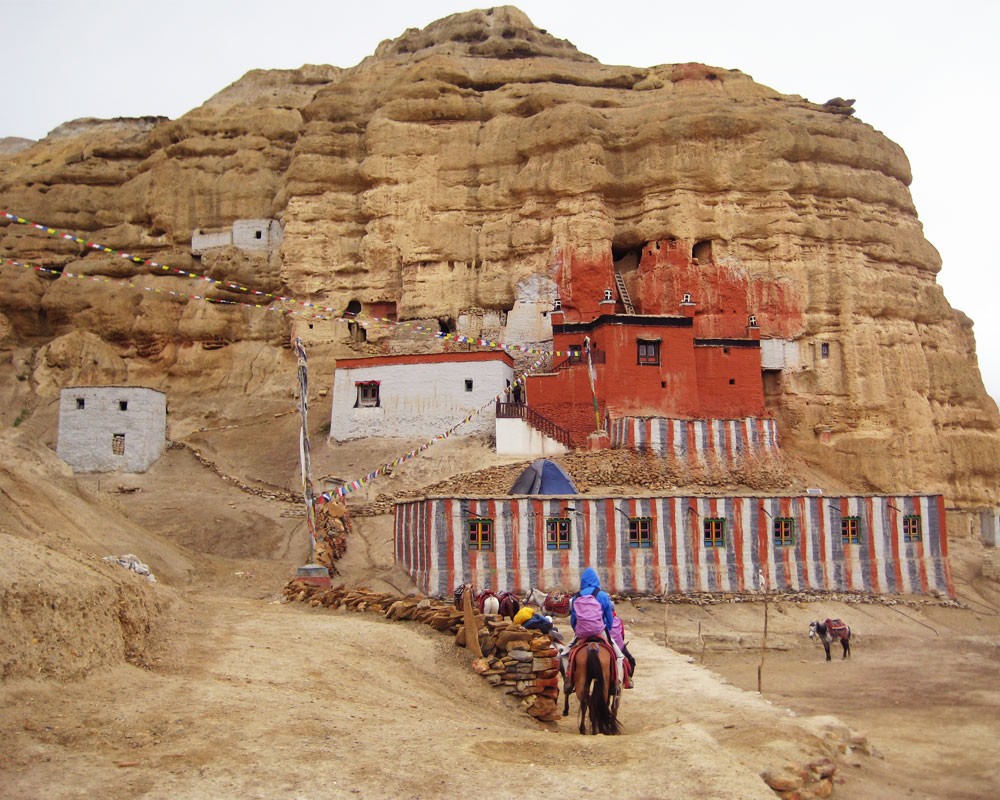
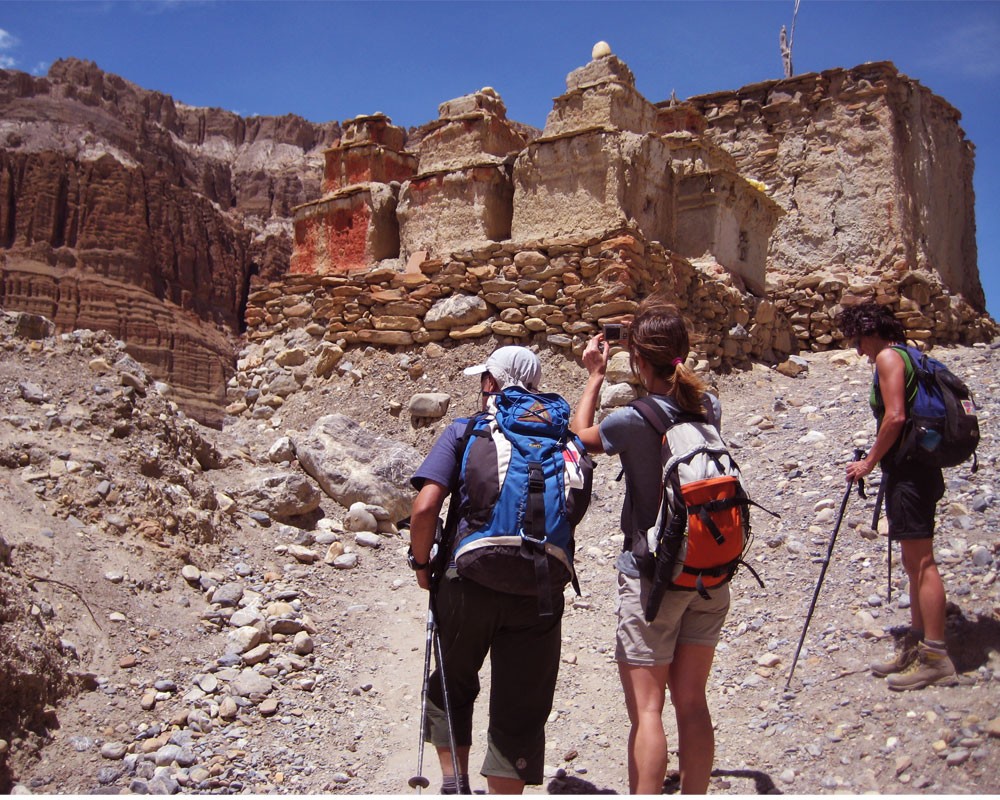
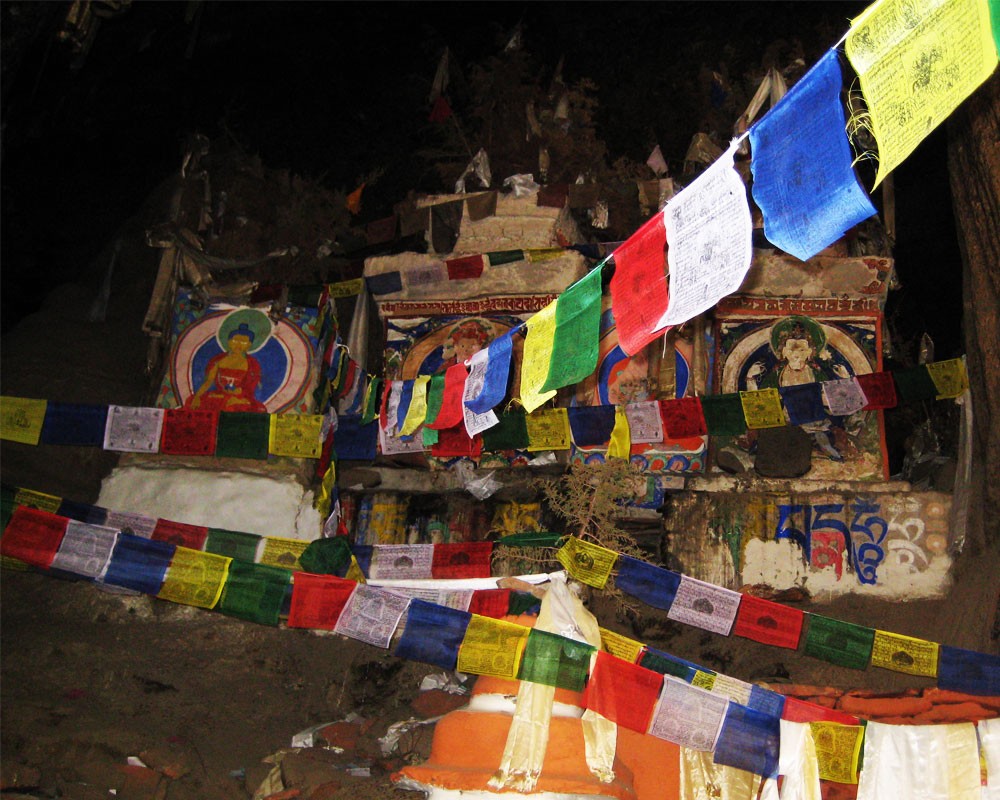
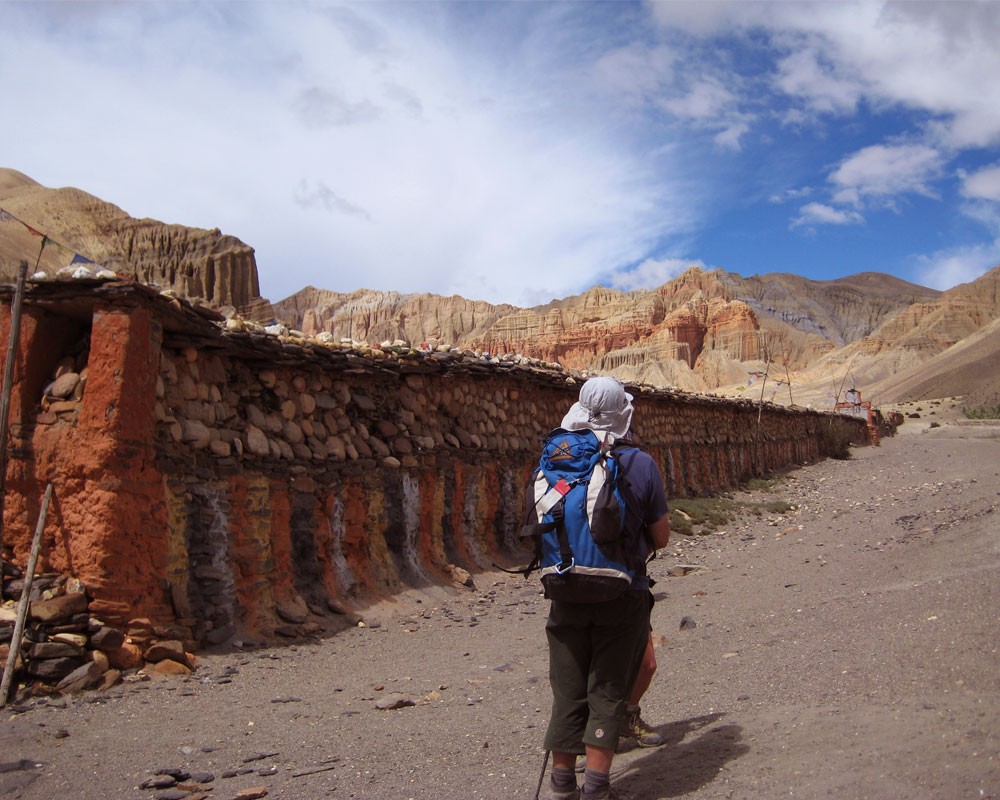
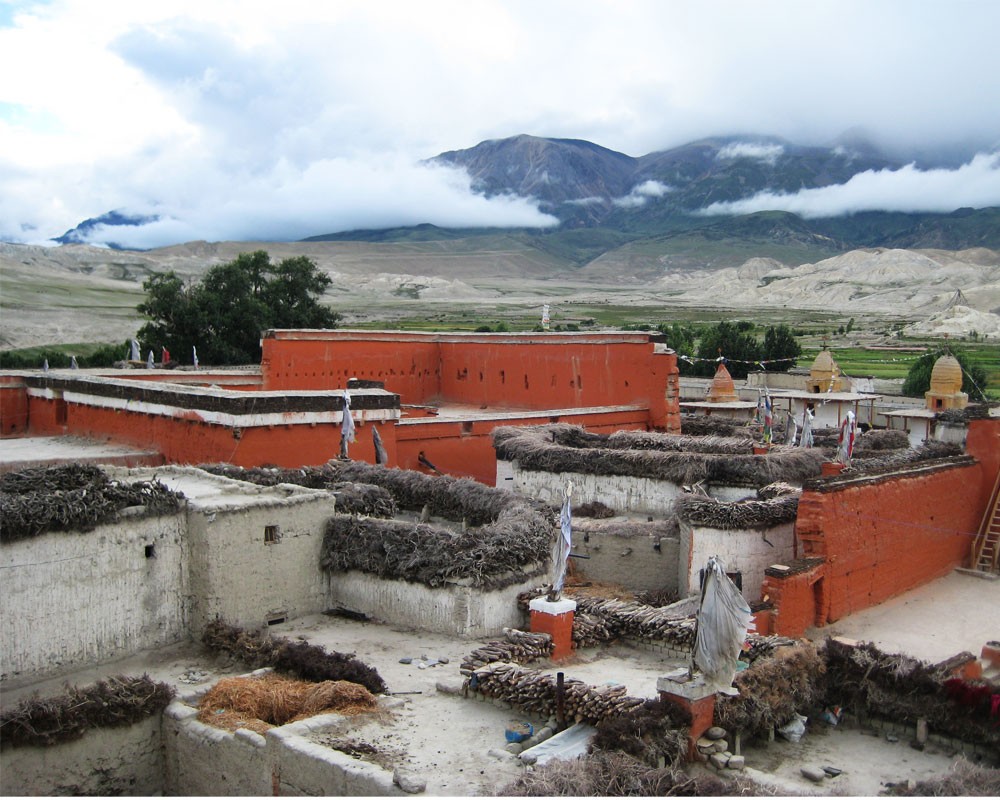
That isolation is the point. Walking through Upper Mustang today, you are moving through a living Tibetan Buddhist civilisation that has remained largely intact — ochre-painted monasteries, sky caves carved into cliff faces four storeys high, mani walls that stretch for hundreds of metres, and the walled capital of Lo Manthang, which has looked roughly the same for six hundred years.

This is not a trek you do because you want a mountain summit or a famous base camp photo. You do this trek because you want to walk into a world that most travellers never reach — and understand why it was worth protecting.

Why Trek to Mustang Rather Than Drive to Mustang?

There is a Luxury Upper Mustang Jeep Tour available — and for the right traveller, it is the right choice. But the trek and the jeep tour deliver fundamentally different experiences.

On foot, you enter at the pace Upper Mustang was always meant to be entered. You cross passes at 3,850 m and watch the landscape shift beneath you — river canyons dropping away, red-and-ochre cliffs rising, the scale of it becoming real in a way that a windscreen cannot replicate. You stop in villages that the road skirts around. Your guide points out a monastery entrance that the jeep would have passed in seconds. You arrive at Lo Manthang with the full weight of where you have walked from.

For travellers who have done Everest Base Camp or the Annapurna Circuit, this is the trek that goes further — in distance, in altitude, in cultural depth, and in the feeling of having genuinely earned what you find at the end.

If you want the region without the walking, the jeep tour delivers it well. But if you want Upper Mustang as it was always meant to be experienced — trek it.

What You Will Actually Experience

The Landscape

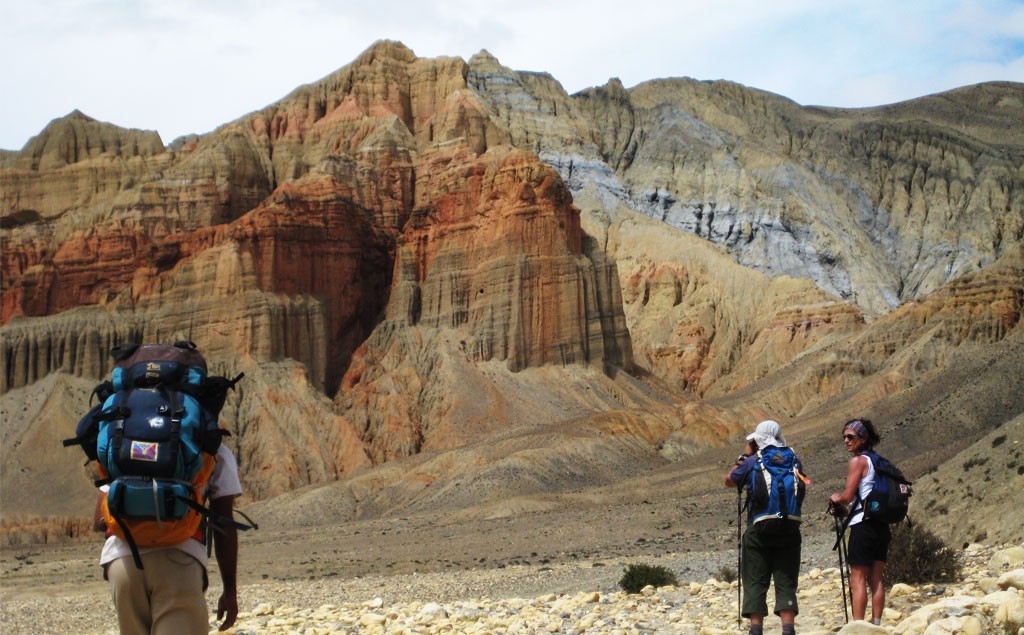
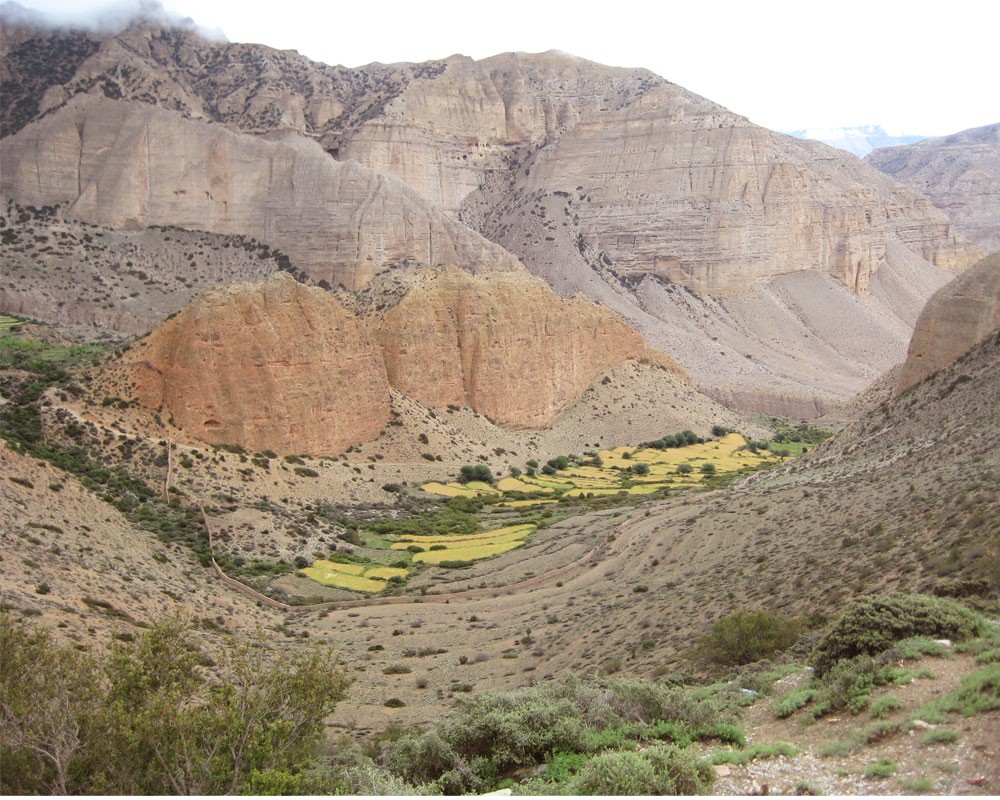
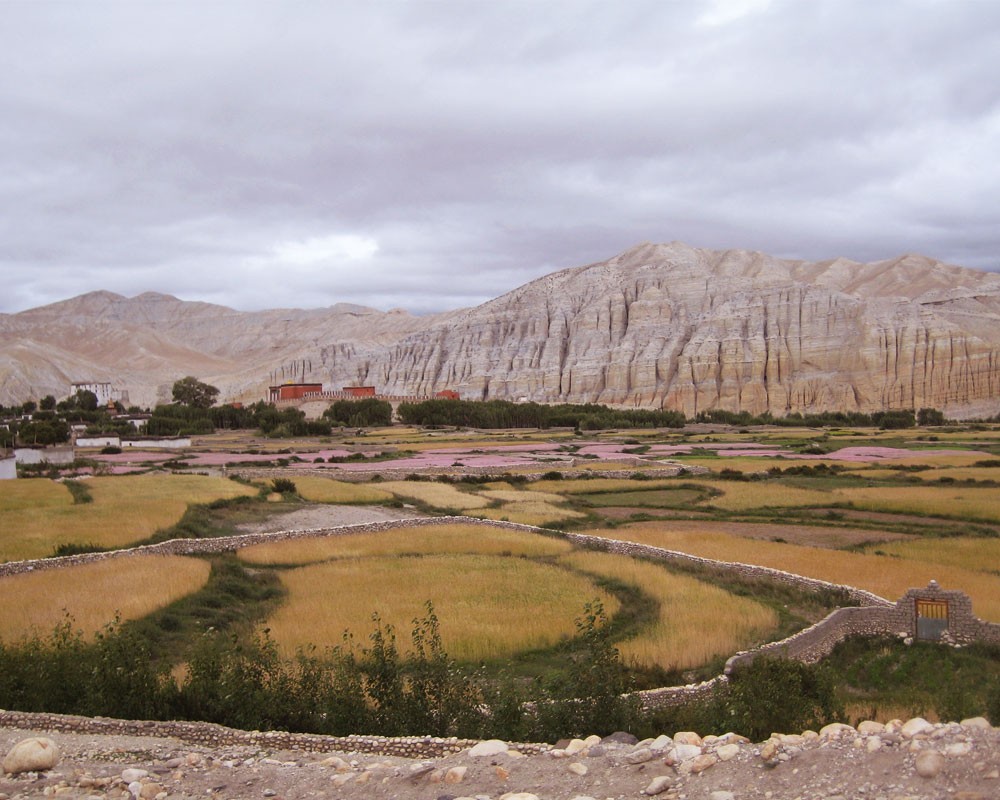
Upper Mustang is a Himalayan desert. That distinction matters. The Annapurna and Dhaulagiri massifs block the monsoon entirely, leaving a Trans-Himalayan plateau of wind-carved canyons, sand-coloured ridges, and sky that feels wider than anywhere else in Nepal. Walking through it is unlike any other trekking landscape in the country — closer to the high desert of Central Asia than the green hill country most people imagine when they picture Nepal.

The Passes

The standard Upper Mustang trek crosses five significant passes: Taklam La (3,624 m), Dorje La (3,735 m), Yamda La (3,850 m), Nyi La (4,010 m), and Charang La (3,870 m). These are not technical climbs, but they require good fitness and acclimatisation. The uphill effort buys you views that cannot be reached any other way.

The Villages

Chele, Syangboche, Ghami, Charang — each village on the Upper Mustang trail has its own character, its own monastery, its own version of the Tibetan Buddhist life that has shaped this region for centuries. These are not tourist villages. People here farm buckwheat and barley, tend their horses, and perform daily rituals that predate the permit system by a thousand years. Walking through them slowly, on foot, with a guide who speaks the language and knows the families — that is what makes this trek different.

Lo Manthang

The walled city of Lo Manthang at 3,700 m is the destination at the heart of this trek. It is compact — you can walk the perimeter in twenty minutes — but what is inside those mud-brick walls is extraordinary. The Thubchen Monastery, with its floor-to-ceiling murals painted in the 15th century. The King's Palace, still standing and still inhabited. The narrow lanes that connect them are largely unchanged for generations. We spend a full day here — not rushing, not ticking, just being present in a place that most of the world has never seen.

The Tiji Festival (if timing aligns)

If your dates align with May, the Tiji Festival in Lo Manthang is one of the most extraordinary ritual events in the Himalayas — three days of masked dance performed by monks in the courtyard of the palace, enacting the defeat of a demon god and the renewal of the Kingdom of Lo. It is not staged for visitors. It happens whether trekkers are there or not. We just have the privilege of witnessing it.
Also, this is an add-on. So, better to contact us first.

How We Run This Trek

Upper Mustang is one of the routes where the quality of your guide defines the quality of your experience. The landscape speaks for itself. But Lo Manthang's monasteries, the meaning behind the mani walls, the story of the Kingdom of Lo, the correct way to enter a prayer hall, what you are watching when you see monks perform a ritual — none of that lands without someone who knows it deeply and communicates it naturally.

Our guides for Upper Mustang are briefed specifically for each group before departure — not generically, but specifically. What are you interested in? At what pace do you walk? Whether you want quiet time in the monasteries or a guided explanation. Whether you are a photographer who needs the light handled correctly. The guide adjusts to you, not the other way around.

We operate in small groups. The permit system already caps volume; we add our own cap. Smaller groups move more naturally through village life, get more access in monasteries, and simply have a better experience on the trail.

Porters carry the main load (up to 15 kg per trekker). You walk with only what you need for the day.

Trek at a Glance

DetailInfo
Duration17 Days
DifficultyStrenuous
Maximum Altitude3,810 m / 12,500 ft (Lo Manthang)
Highest PassNyi La — 4,010 m
Trek Start / EndKathmandu
Group SizePrivate or small group
Best SeasonMarch–May, September–November
Permit RequiredRAP + ACAP + TIMS
Solo TrekkingPermitted (from March 2026, guide mandatory)

Itinerary

Show Detail ItineraryClose Detail Itinerary

In accordance with your flight schedule, we will be at the Tribhuvan International Airport, Kathmandu to extend a warm welcome to you in our beautiful country for the beautiful trip. After exchanging warm welcome greetings at the arrival section, we will lead you to our vehicle to drop you off at our trip hotel. It’s a day at complete leisure, you will be on your own and you can do whatever you want to do for refreshment. But we definitely will be happy to guide you around the city.

On the second day of arrival, we will be interacting with each other. After early breakfast, every guest needs to arrive at the Company to review their trip so that they can buy and manage the required stuff for their trips. After talking about the trip we will be taking our guests for a cultural sightseeing tour around Kathmandu valley.

The destination for sightseeing includes Swoyambhunath - the oldest monument in Kathmandu valley, Kathmandu Durbar Square – to see the temple of Living Goddess and other medieval architectural wonders, Pashupatinath – to immerse into Hindu death rites on the bank of a holy river, and Boudhanath – a massive Buddhist shrine considered as the biggest in the world.

We will head to Pokhara (900 m) today on an overland journey. The road journey of about 6 hours starts after breakfast and heads towards the west of Kathmandu valley past Swoyambhunath aka monkey temple. As soon as we get outside Kathmandu valley from the western ridge, we can immediately experience the charm of rural Nepal. The drive has beautiful views of Himalayan peaks and countryside hills. The highway runs through small towns, river banks,s and winding curl exposing rural Nepalese wonders to us.

After reaching Pokhara we can feel the welcome of this beautiful lake city. We will stay overnight at Lakeside. We will have free time to wander around the lakeside on our own once we check in to the hotel. 

From the fourth day onward we will organize official trekking. We will question and check up on guests if they are okay and if their physical condition is at the top-notch condition for trekking or not. Once the health check-up is completed we will set off on the first day of trekking today but before we have to take a scenic flight to Jomsom. We will drive to the airport for our morning flight to the beautiful headquarters of Mustang, Jomsom. We will fly closely past the spectacular Annapurna range and enter the Kali Gandaki valley overlooking the Dhaulagiri range in the Himalayas.

A memorable twenty minutes of flight lands at Jomsom (2,700 m) where we meet our complete trekking crew. We will then prepare for the walk of the day to Kagbeni, a beautiful village on the bank of the Kali Gandaki River. The sandy trail goes along the river bank and gets windy in the afternoon. Despite the windy condition on the trail, the stretch is scenic and we enjoy walking on it.

Our trek continues on the deserted, sandy trail up towards the Upper Mustang. The destination of our trek for the day is Chaile, a beautiful village in the region. We will continue our trek along the Kali Gandaki River and enjoy the charm that the river valley has to offer.

After a while, our trail will ascend to Tangbe, a local village that comes along the trail today. The uniqueness of the village in its formation is so wonderful that we keep admiring its beauty. We walk further towards the destination and eventually reach Chaile after about 6 hours of walk. Chaile is another wonderful village that bears the unique cultural riches of the region. 

We will walk over two passes on our trek today. We cross Taklam La 3,624m and Dorje La 3,735m before reaching the destination today. As the stretch today involves lots of uphill and downhill walking at a high altitude, it’s going to be a challenging day for us. But the challenge is well worth it as we can enjoy a spectacular view that is unlike from anywhere. We walk past Samar village and continue the trek to Syangboche village for an overnight stay.

The stretch of the walk today has another high pass for us to cross. We cross Yamda La at the elevation of 3,850 meters and Nyi La at the elevation of 4,010 meters above sea level on our trek to Ghami today. These two passes bring some spectacular views of the mountains and a uniquely different landscape. We walk up and down the passes and eventually reach Ghami village after about six hours of challenging walk. Ghami village is a village with fascinating culture and surrounding to explore and enjoy.

We will slowly gain elevation for our overnight places each day although we walk past high passes on our walk on the previous days. The challenging day involves a walk over another pass called Charing La at the elevation of 3,870 meters above sea level. The ascents and descents on the stretch today bring some majestic views, Mani walls, and wonderful landscapes to our site. The beautiful Charing village offers a rich cultural and spiritual immersion that we can explore as soon as we reach there.

After early morning breakfast, we begin our trek to Lo Manthang. As we leave Charang and descend around 125 meters from Charang, we cross the Tsarang Chu. After crossing the Tsarang Chu, our trail leads us to the track full of stones lying just opposite the village at 3580m entering the Tholung Village. Then the trail further ascends to the windy pass of Lo (3850m) and from there you will get the first glimpse of the walled city Lo-Manthang at 3700m. A short descent from there leads to the plain of aspiration and then the trail crosses a stream and climbs up onto the plateau of Lo-Manthang.

We will spend an extra day here at Lo Manthang exploring the wonders this place has to offer to the modern world. The simplicity in lifestyle and devotion to their faith is what people in this walled city have been living for ages. We go to explore beautiful monasteries and other areas in Lo Manthang. A full day is well spent exploring the wonders of the Upper Mustang that brought us here. The day is surely full of inspiring experiences.

We will set off on our return trip early today and trek to Drakmar. Drakmar will be the highest overnight place of the trip. On the trail to the destination, we can explore an ancient Buddhist monastery and rock paintings. We can make a wish here as people believe that the wish made here comes true. After making our wish at the monastery, we trek further to Drakmar, our destination of the day.

The walk on this day starts really early to make it easier for the day as the trail can get as windy as anything in the afternoon. The sooner we start the better for us. Although the walk itself is not that challenging, the atmospheric condition can create a little trouble. Sandy terrain and the strong gust of wind don’t go well along. Traversing the dry trail down the sandy landscape, we finally reach Geling (3,805 m) for our overnight stay.

We will start early and walk to Chhuksang. We will cover a huge drop in the elevation so the trail will mostly descend toward the destination. The stretch today brings fabulous views of the snow-capped mountains in addition to the wonderful landscape that the region has. We reach Chhuksang after about six hours of trekking. Chhuksang (3,050 m) is a small village in the region with great cultural wonders.

It’s the final day of the walk today. We will trek all the way down to Jomsom today and finish the walking part of the Upper Mustang trip. The trail descends to Kagbeni and goes along the Kali Gandaki River to Jomsom (2,700 m). Then we will celebrate the end of the trekking part; express our hearty thanks to the crew members who made this trip possible by being with us throughout to help. 

A short but overwhelming flight to Pokhara across the mountains is due morning on this day. We board the plane and fly southward from Jomsom passing through several gigantic snow-capped mountains. It’s an incredible mountain flight experience of about 20 minutes.

Once in Pokhara, we have leisurely time on our own to go explore the town. We can find massage to relieve the tiredness of trekking or simply walk around the lakeside. There are options of going for some adventure activities like paragliding, zip flying, bungee jumping, and ultra-light flight, etc.

We will take a drive back to Kathmandu via the same highway we took earlier to go there.

Once in Kathmandu, we spend leisurely time back in the chaos of the city after so many days of serene mountain air and incredible adventure.

    On the last day of this trip, we drive you to the airport as per your flight schedule back to home or onward destination.

    We definitely hope that you enjoyed the Upper Mustang Trek and hope to see you for another adventure soon.

    Not satisfied with this regular itinerary?

    Are you thinking to plan your custom trip now.

    Cost Details

    Included

    • 3-star hotel accommodation in Kathmandu and Pokhara with breakfast

    • Teahouse accommodation during the trek

    • All meals (breakfast, lunch, and dinner) during the trek

    • Farewell dinners

    • All ground transportation on a comfortable private vehicle as per the itinerary

    • Domestic flights (Pokhara-Jomsom-Pokhara)

    • Guided city tour in Kathmandu by private vehicle

    • Entrance fees for sightseeing/monument visits as per the itinerary

    • An experienced, English-speaking, and government-licensed trek leader and assistant trek leader

    • Porter service

    • Staff costs including their salary, insurance, equipment, domestic airfare, food, and accommodation

    • Himalayan scenery's trekking bag/duffel bag, t-shirt, and trekking map are yours to take

    • All necessary paperwork and trekking permits (National Park Permit, TIMS)

    • Medical kit (carried by your trek leader)

    • All government and local taxes

    Excluded

    • Nepalese visa fee 
    • Excess baggage charge(s)
    • Extra night accommodation in Kathmandu and Pokhara because of early arrival, late departure, early return from mountain (due to any reason) than the scheduled itinerary
    • International flights
    • Travel and rescue insurance
    • Personal expenses (phone calls, internet, laundry, bar bills, battery recharge, extra porters, bottled or boiled water, shower, etc.)

    Useful Info

    Permits and Access: What You Need to Know in 2026

    Upper Mustang is a Restricted Area. Every non-Nepali trekker requires permits before entering beyond Kagbeni. The army and police enforce this consistently — missing documentation means turning around at the checkpoint.

    HST handles the entire permit process on your behalf. You do not need to visit any government office or queue at the Department of Immigration.

    Permit Requirements

    Documents you need to provide to HST at booking:

    • Passport copy

    • Nepal visa number (the RAP can only be processed after you arrive in Nepal and have your visa)

    • Passport-sized photographs (4 copies recommended)

    Important: The Restricted Area Permit cannot be arranged before you land in Nepal. Your visa number is required for the application. HST will process everything within 3–7 working days of your arrival — this is factored into the Kathmandu days at the start of your itinerary.

    Restricted Area Permit (RAP)

    This is the essential permit for Upper Mustang — everything beyond Kagbeni requires it. It is issued by Nepal's Department of Immigration and can only be applied for through a registered trekking agency. Individual applications are not accepted.

    Cost: USD 50 per person per day inside the restricted zone (from Kagbeni onward). On a standard 17-day itinerary with approximately 10 days inside the zone, this comes to around USD 500 per person.

    Solo trekking (from March 22, 2026): The two-person minimum has been officially removed. Solo travellers can now obtain the RAP independently, provided they are accompanied by a licensed Nepali guide and book through a registered agency. HST manages the full application for solo travellers.

    Group size: One licensed guide can accompany up to seven trekkers under 2026 regulations.

    Extensions: If you wish to stay longer inside the restricted zone, extensions are available through the Department of Immigration office in Jomsom at the same daily rate of USD 50. Your guide coordinates this.

    Permit validity: Begins on the day you enter the restricted area at Kagbeni. You must exit before midnight on the final permitted day — there is no grace period.

    ACAP and TIMS

    For the Annapurna Conservation Area Permit (ACAP) and TIMS card, a copy of your passport and visa is sufficient. HST processes both as part of your package — no additional action required from you.

    How HST Handles It

    Once you arrive in Kathmandu and share your visa number with us, we submit your RAP application immediately. Processing typically takes 3–7 working days. Your Kathmandu arrival days are structured to accommodate this — by the time you fly to Jomsom, everything is in order.

    Ready to start the process?Send us your details, and we'll handle the rest.

    For a full breakdown of the Upper Mustang permit structure, see our Upper Mustang Permit Guide or our dedicated Upper Mustang Trek Cost page.

    Best Time to Trek Upper Mustang

    Upper Mustang's rain shadow location means the seasonal calendar here works differently from almost every other Nepal trek.

    Spring (March – May): The most popular season. Temperatures are manageable, the landscape blooms with wildflowers in the lower valleys, and May brings the Tiji Festival in Lo Manthang. This is peak season — book early.

    Monsoon (June – August): Counterintuitively, this is one of the best-kept secrets in Nepal trekking. Because the Annapurna and Dhaulagiri massifs block the monsoon rain, Upper Mustang stays largely dry while the rest of Nepal floods. The landscape turns slightly greener, the villages are quieter, and permit costs are the same. For experienced trekkers who want solitude, this window is genuinely excellent.

    Autumn (September – November): The classic Nepal trekking season. Skies are clear, visibility is at its best, and the temperatures are ideal. October is the single best month for mountain views from the passes.

    Winter (December – February): Cold, occasionally severe, with some high passes carrying snow. This is not recommended for most trekkers, though the region does not fully close.

    Physical Preparation: What "Strenuous" Means Here

    The Upper Mustang trek is graded strenuous — not because of extreme technical difficulty, but because of sustained altitude, daily distance, and multiple high passes in sequence.

    What to expect:

    • Daily walking: 5–7 hours on most days

    • Altitude: You spend the majority of the trek above 3,000 m, with passes reaching 4,010 m (Nyi La)

    • Terrain: Dry, sandy trails, loose stone on pass ascents, wind-exposed ridgelines — particularly in the afternoon when the Kali Gandaki valley channels strong gusts

    • Cumulative fatigue: The challenge is not any single day, but the accumulation of pass crossings over the full route

    Who it suits:
    Trekkers who are comfortable with multi-day high-altitude walking and have some prior trekking experience. Annapurna Base Camp or a similar trek beforehand is ideal preparation. This is not a first-time trekking route.

    For a comparison of difficulty and experience, see Manaslu Circuit Trek — another restricted area route with a different character.

    Accommodation on the Route

    Upper Mustang has developed meaningfully as a trekking destination. In the main villages — Kagbeni, Chele, Ghami, Charang, and Lo Manthang — teahouses and lodges have improved considerably over the past decade, driven in part by the permit revenue flowing back into the region.

    In Lo Manthang itself, several well-regarded guesthouses offer comfortable rooms, reliable meals, and enough warmth that the experience of the walled city is not diminished by the conditions of where you sleep.

    What you will not find on most of this route: international hotel standards, consistent hot showers, or private en-suite bathrooms in all locations. What you will find: genuine hospitality, locally sourced food (buckwheat pancakes, dal bhat, tsampa), and the satisfaction of staying inside the communities you have walked to reach — not alongside them.

    Kathmandu and Pokhara: 3-star hotel accommodation with breakfast is included. Upgrades to 4/5-star properties are available in Kathmandu on request.

    Single supplement: USD 290 for the full trek duration. In the most remote sections, single rooms may not always be available.

    Frequently Asked Questions

    Can I trek Upper Mustang solo?

    Yes — as of March 22, 2026, the two-person minimum requirement has been officially removed. Solo trekkers can now obtain the Restricted Area Permit, provided they book through a registered agency and are accompanied by a licensed Nepali guide. HST manages the full permit application for solo travellers.

    How much does the Upper Mustang permit cost in 2026?

    The RAP (Restricted Area Permit) now costs USD 50 per person per day inside the restricted zone, which begins at Kagbeni. The old USD 500 flat fee was abolished in late 2025. On a 17-day itinerary with approximately 10 days inside the zone, the RAP cost is around USD 500 per person. You also need an ACAP permit (NPR 3,000) and a TIMS card (USD 20), both of which are included in your HST package.

    Is Upper Mustang doable during the monsoon?

    Yes — and it is one of Nepal's best-kept trekking secrets. Upper Mustang sits in the rain shadow of the Annapurna and Dhaulagiri ranges, which means it receives very little rainfall even during the peak monsoon (June–August). Trail conditions remain good, the landscape has slightly more colour, and you will share it with far fewer people than in spring or autumn.

    What is Lo Manthang?

    Lo Manthang is the walled capital of the former Kingdom of Lo — a semi-autonomous Tibetan Buddhist monarchy established in 1380 CE. The city walls, the 15th-century Thubchen Monastery, and the King's Palace are all still standing and still in use. It is the cultural and historical centrepiece of the entire Upper Mustang trek.

    What is the Tiji Festival?

    Tiji (Tenchi) is a three-day Buddhist ritual performed annually in Lo Manthang, usually in May. Monks in elaborate costumes perform masked dances enacting the defeat of a demon god and the protection of the Kingdom of Lo. The 2026 dates were May 13–15. If your dates align, the Tiji Festival Trek is a dedicated package built around this event.

    How does the Jomsom flight work?

    A scenic 20-minute mountain flight connects Pokhara to Jomsom (2,700 m) — you fly parallel to the Annapurna and Dhaulagiri ranges in a small aircraft. These flights operate in the early morning only; afternoon winds in the Kali Gandaki valley make flying impossible. In the event of flight cancellation (weather-related), your HST team will advise on alternatives. Travel insurance covering domestic flight disruption is strongly recommended.

    How does this differ from the Luxury Upper Mustang Jeep Tour?

    The jeep tour covers similar geography in less time, with a focus on major sites and a higher standard of comfort throughout. The trek delivers a fundamentally different experience — slower, more physical, more immersive in village life, and with access to areas the road does not reach. Both are excellent options depending on your travel style and available time.

    What physical preparation do you recommend?

    Ideally, 4–6 weeks of regular cardio training before departure, with at least one multi-day hiking experience above 2,500 m. The Annapurna Base Camp Trek or a similar route in the months prior would be ideal preparation. If this is your first high-altitude trek, speak to us before booking.

    Related Treks and Tours

    Ready to Plan Your Upper Mustang Trek?

    Upper Mustang does not need to be rushed into. If you have questions about fitness, permits, dates, or whether this is the right trek for you — ask us directly. We have walked this route repeatedly and can tell you honestly what to expect.

    Send an Enquiry | Customise This Trek | Call +977 9851083619

    Send Inquiry